Machine Coding Round Complete Guide
Problem Statement
Create a snake and ladder application. The application should take as input (from the command line or a file):
- Number of snakes (s) followed by s lines each containing 2 numbers denoting the head and tail positions of the snake.
- Number of ladders (l) followed by l lines each containing 2 numbers denoting the start and end positions of the ladder.
- Number of players (p) followed by p lines each containing a name.
After taking these inputs, you should print all the moves in the form of the current player name followed by a
random
number between 1 to 6 denoting the die roll and the initial and final position based on the move.
Format: <player_name> rolled a <dice_value> and moved from <initial_position> to <final_position>
When someone wins the game, print that the player won the game.
Format: <player_name> wins the game
Rules of the game
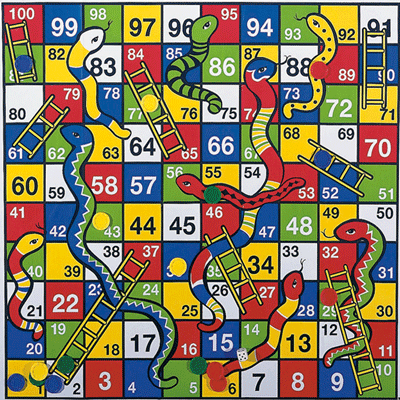
- The board will have 100 cells numbered from 1 to 100.
- The game will have a six sided dice numbered from 1 to 6 and will always give a random number on rolling it.
- Each player has a piece which is initially kept outside the board (i.e., at position 0).
- Each player rolls the dice when their turn comes.
- Based on the dice value, the player moves their piece forward that number of cells. Ex: If the dice value is 5 and the piece is at position 21, the player will put their piece at position 26 now (21+5).
- A player wins if it exactly reaches the position 100 and the game ends there.
- After the dice roll, if a piece is supposed to move outside position 100, it does not move.
- The board also contains some snakes and ladders.
- Each snake will have its head at some number and its tail at a smaller number.
- Whenever a piece ends up at a position with the head of the snake, the piece should go down to the position of the tail of that snake.
- Each ladder will have its start position at some number and end position at a larger number.
- Whenever a piece ends up at a position with the start of the ladder, the piece should go up to the position of the end of that ladder.
- There could be another snake/ladder at the tail of the snake or the end position of the ladder and the piece should go up/down accordingly.
Assumptions you can take apart from those already mentioned in rules
- There won’t be a snake at 100.
- There won’t be multiple snakes/ladders at the same start/head point.
- It is possible to reach 100, i.e., it is possible to win the game.
- Snakes and Ladders do not form an infinite loop.
Sample Input
9
62 5
33 6
49 9
88 16
41 20
56 53
98 64
93 73
95 75
8
2 37
27 46
10 32
51 68
61 79
65 84
71 91
81 100
2
Gaurav
Sagar
Sample Output
Gaurav rolled a 6 and moved from 0 to 6
Sagar rolled a 1 and moved from 0 to 1
Gaurav rolled a 6 and moved from 6 to 12
Sagar rolled a 4 and moved from 1 to 5
Gaurav rolled a 4 and moved from 12 to 16
Sagar rolled a 6 and moved from 5 to 11
Gaurav rolled a 5 and moved from 16 to 21
Sagar rolled a 4 and moved from 11 to 15
Gaurav rolled a 1 and moved from 21 to 22
Sagar rolled a 6 and moved from 15 to 21
Gaurav rolled a 6 and moved from 22 to 28
Sagar rolled a 2 and moved from 21 to 23
Gaurav rolled a 6 and moved from 28 to 34
Sagar rolled a 6 and moved from 23 to 29
Gaurav rolled a 5 and moved from 34 to 39
Sagar rolled a 2 and moved from 29 to 31
Gaurav rolled a 2 and moved from 39 to 20
Sagar rolled a 5 and moved from 31 to 36
Gaurav rolled a 3 and moved from 20 to 23
Sagar rolled a 5 and moved from 36 to 20
Gaurav rolled a 6 and moved from 23 to 29
Sagar rolled a 3 and moved from 20 to 23
Gaurav rolled a 2 and moved from 29 to 31
Sagar rolled a 3 and moved from 23 to 26
Gaurav rolled a 3 and moved from 31 to 34
Sagar rolled a 5 and moved from 26 to 31
Gaurav rolled a 3 and moved from 34 to 37
Sagar rolled a 4 and moved from 31 to 35
Gaurav rolled a 2 and moved from 37 to 39
Sagar rolled a 5 and moved from 35 to 40
Gaurav rolled a 2 and moved from 39 to 20
Sagar rolled a 5 and moved from 40 to 45
Gaurav rolled a 2 and moved from 20 to 22
Sagar rolled a 6 and moved from 45 to 68
Gaurav rolled a 3 and moved from 22 to 25
Sagar rolled a 3 and moved from 68 to 91
Gaurav rolled a 5 and moved from 25 to 30
Sagar rolled a 2 and moved from 91 to 73
Gaurav rolled a 5 and moved from 30 to 35
Sagar rolled a 6 and moved from 73 to 79
Gaurav rolled a 5 and moved from 35 to 40
Sagar rolled a 1 and moved from 79 to 80
Gaurav rolled a 4 and moved from 40 to 44
Sagar rolled a 2 and moved from 80 to 82
Gaurav rolled a 5 and moved from 44 to 9
Sagar rolled a 4 and moved from 82 to 86
Gaurav rolled a 1 and moved from 9 to 32
Sagar rolled a 6 and moved from 86 to 92
Gaurav rolled a 3 and moved from 32 to 35
Sagar rolled a 4 and moved from 92 to 96
Gaurav rolled a 1 and moved from 35 to 36
Sagar rolled a 1 and moved from 96 to 97
Gaurav rolled a 1 and moved from 36 to 37
Sagar rolled a 5 and moved from 97 to 97
Gaurav rolled a 6 and moved from 36 to 42
Sagar rolled a 3 and moved from 97 to 100
Sagar wins the game
Expectations
- Make sure that you have a working and demonstrable code
- Make sure that the code is functionally correct
- Code should be modular and readable
- Separation of concern should be addressed
- Please do not write everything in a single file
- Code should easily accommodate new requirements and minimal changes
- There should be a main method from where the code could be easily testable
- [Optional] Write unit tests, if possible
- No need to create a GUI
Optional Requirements
Please do these only if you’ve time left. You can write your code such that these could be accommodated without changing your code much.
- The game is played with two dice instead of 1 and so the total dice value could be between 2 to 12 in a single move.
- The board size can be customizable and can be taken as input before other input (snakes, ladders, players).
- In case of more than 2 players, the game continues until only one player is left.
- On getting a 6, you get another turn and on getting 3 consecutive 6s, all the three of those get cancelled.
- On starting the application, the snakes and ladders should be created programmatically without any user input, keeping in mind the constraints mentioned in rules.
Setup process
Please go through the setup process here.
Submission
- Try to solve it within 1.5 hours.
- Please go through the submission process here.